
CTR: The Case Study
Whether clicks move rankings used to be an argument. It is not one any more. Here is what is on the record.
Sign Up NowUnder oath, 2023
“One of the important signals that we have.”
The Argument Is Settled
Three things happened between 2023 and 2024. Together they ended a decade of guessing.
- 2023Sworn testimony
Google said it out loud, under oath
Google spent years denying that clicks affect rankings. Then its VP of Search took the stand in the DOJ antitrust trial and called NavBoost, the system that re-ranks results using clicks, one of the important signals they have. That was the first time Google admitted it.
US DOJ v. Google - 2024Leaked documentation
Then the internal docs named the metrics
In May 2024, Google’s own search documentation turned up on a public GitHub repository. 2,500 pages, 14,014 attributes. It listed the click signals by name: goodClicks, badClicks and lastLongestClicks. Former Google staff confirmed the documents were real.
SparkToro - 2024How it is measured
It counts 13 months at a time
NavBoost looks at 13 months of clicks at once, split by country and by device. That long window is the reason a quick burst of traffic does nothing, and the reason steady campaigns are the ones that move.
Trial disclosures
What About AI Overviews and AI Search?
Ranking first helps a lot. It does not guarantee anything. The 2026 data says both of those at once, so here is the whole picture rather than the flattering half.
3.5x
Ranking first makes you far likelier to be cited
43.2% of pages sitting at number one get cited by ChatGPT. Pages outside the top 20 are cited at a rate three and a half times lower. Rank is not the only way into an AI answer, but it is the biggest lever you actually control.
AI citation research, 202638%
But most AI citations no longer come from the top 10
That is down from 76% in mid-2025, measured across 863,000 keywords and 4 million AI Overview URLs. Google now breaks one question into several and cites whatever does well across all of them, so plain ranking counts for less than it did.
Ahrefs, March 202665%
And fewer people click at all
On searches that show an AI Overview, organic click-through falls from 1.76% to 0.61%. Fewer people click through at all, which makes the clicks you do get worth more to a system that measures click quality.
Seer Interactive, November 2025What Google Said Before It Was Proven
The testimony confirmed what the paper trail had been saying for over a decade.
[…] user reactions to particular search results or search result lists may be gauged, so that results on which users often click will receive a higher ranking.US Patent 8,938,463
[…] using click and visit data to rank results is a very reasonable and logical thing to do, and ignoring the data would have been silly. […] It’s pretty clear that any reasonable search engine would use click data on their own results to feed back into ranking to improve the quality of search results. Infrequently clicked results should drop toward the bottom because they’re less relevant, and frequently clicked results bubble toward the top.Quora
In addition, click data (the website links on which a user actually clicks) is important for evaluating the quality of the search results page. As Google’s former chief of search quality Udi Manber testified: “If we discover that, for a particular query, hypothetically, 80 percent of people click on Result No. 2 and only 10 percent click on Result No. 1, after a while we figure out, well, probably Result 2 is the one people want. So we’ll switch it.”FTC staff report, via the Wall Street Journal
The Experiment That Started It
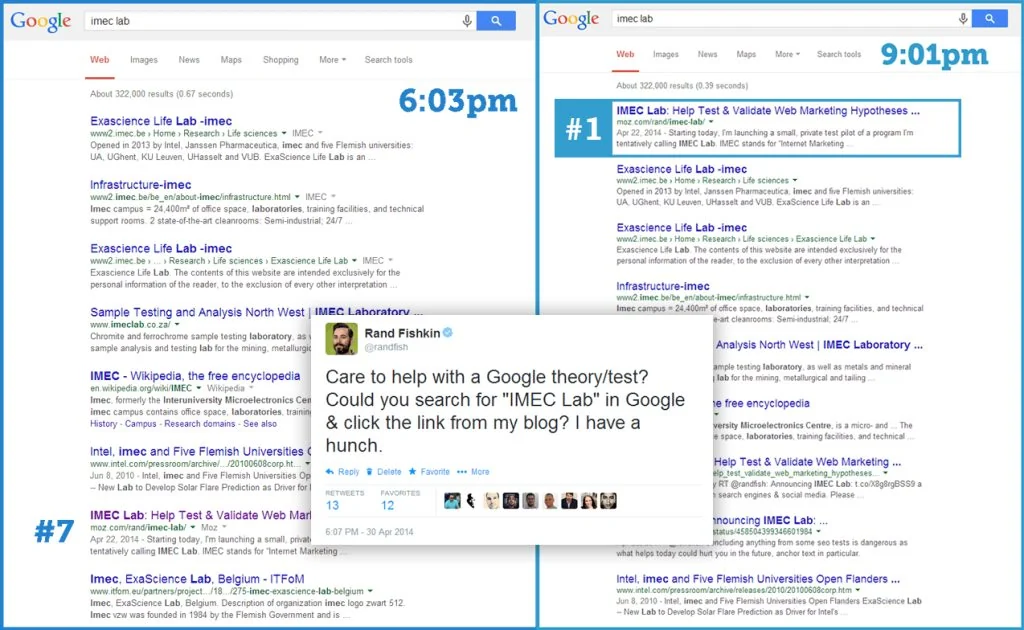
Rand Fishkin, the SEO consultant behind Moz, ran a simple test. He asked people to search a keyword and click his result. His page moved from #7 to #1 in under three hours.
Many reports classify CTR as a powerful SEO factor
Where to Go Next
None of the evidence above is SparkCliks data, and none of it was gathered by us. It is testimony, leaked documentation and published experiments, cited so you can read the originals rather than take our word for any of it. What it establishes is that click behaviour is measured and used. What it cannot tell you is how much any single campaign will move a particular page, and we will not pretend otherwise.